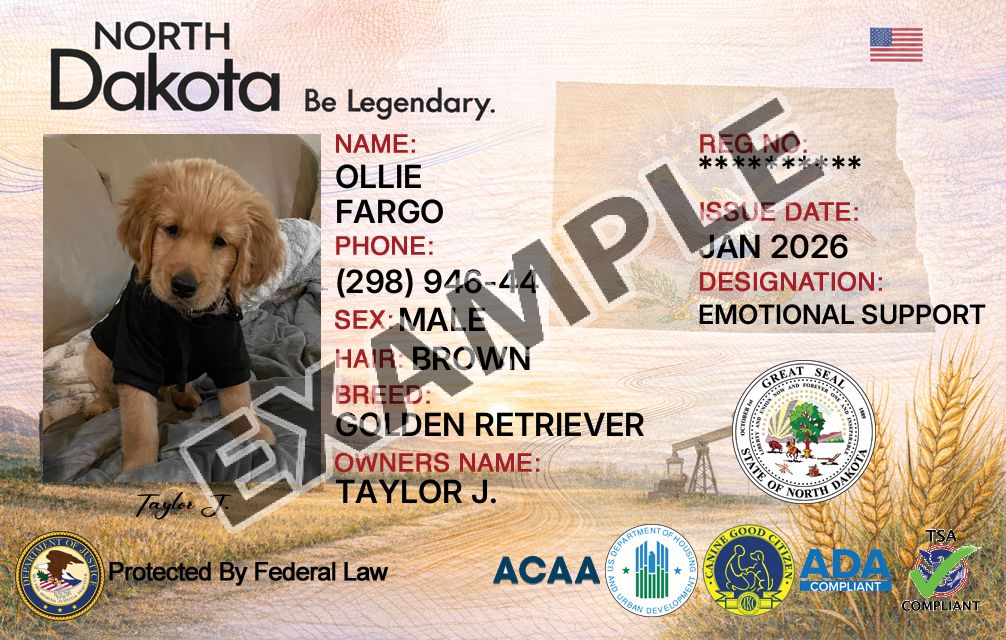
Where do I register my dog in Foster County, North Dakota for my service dog or emotional support dog?
If you’re asking where to register a dog in Foster County, North Dakota, the most important thing to know is that dog licensing is usually handled locally—typically through a city office (if you live inside city limits) or through local county offices or law enforcement contacts that handle animal control and rabies enforcement. Your dog’s status as a service dog or emotional support animal (ESA) does not create a special “service dog registry” at the federal level, and it does not replace local requirements like rabies vaccination rules or an animal control dog license Foster County, North Dakota process where one exists.
Important: “Service dog registration” is not the same as a dog license
In the U.S., there is no federal requirement to register a service animal in a government database, and businesses generally cannot require “registration papers.” However, local dog licensing and rabies rules can still apply even if your dog is a service animal or an ESA. This page focuses on practical, local steps for a dog license in Foster County, North Dakota and what to do next if you live in or near Carrington.
Where to Register or License Your Dog in Foster County, North Dakota
Because pet licensing is often administered by the city you live in (for example, through City Hall or a city auditor/utility billing office), and enforcement questions often run through local law enforcement, the offices below are common starting points in Foster County. Contact them to confirm whether your address is covered by a city license, a county process, or another local requirement.
Local Offices to Contact (Examples)
City of Carrington (City Hall)
- Address
- 103 10th Ave N
- City/State/ZIP
- Carrington, ND 58421
- Phone
- (701) 652-2911
- Office Hours
- Monday - Friday, 8:00 am to 4:30 pm
Foster County Sheriff’s Office
- Address
- 1000 5th St N
- City/State/ZIP
- Carrington, ND 58421
- Phone
- (701) 652-2251
- jcjohn@nd.gov
Foster County Auditor/Treasurer (County Courthouse Offices)
- Address
- 1000 5th St N
- City/State/ZIP
- Carrington, ND 58421
- Phone
- (701) 652-2441
- eroundy@nd.gov
Foster County Public Health
- Address
- 881 Main St
- City/State/ZIP
- Carrington, ND 58421
- Phone
- (701) 652-3087
- Office Hours
- Monday - Friday, 8:00 AM - 12:00 PM & 1:00 PM - 4:30 PM
Tip: If you live inside Carrington city limits, start with City Hall. If you live outside city limits, ask the Sheriff’s Office who handles animal control and whether a county-level dog license or rabies tag system applies where you live.
Overview of Dog Licensing in Foster County, North Dakota
What “registering your dog” usually means
When people search “register my dog,” they usually mean one (or more) of these local requirements:
- Getting a local pet license (often a yearly license) from the city where you live.
- Showing proof of current rabies vaccination (commonly required to receive a license tag).
- Following animal control rules such as leash laws, nuisance rules, or vaccination/rabies enforcement procedures.
Who runs licensing: city vs. county
In North Dakota, dog licensing is often set by local ordinances. That means the correct place to get a dog license in Foster County, North Dakota depends on where you live:
- Inside city limits: many cities issue licenses through City Hall or a city office.
- Outside city limits (rural addresses): enforcement and guidance may run through the county (often via local law enforcement), and requirements may differ by township or local rules.
Rabies vaccination requirements (why they matter for licensing)
Even when the exact licensing office differs, rabies vaccination is a consistent theme: many local pet licenses require proof that the dog’s rabies vaccination is current. Rabies rules also affect what happens after a bite, quarantine rules, and whether your dog can be considered “compliant” during an animal control investigation.
How Dog Licensing Works Locally in Foster County, North Dakota
Step-by-step: how to find the correct licensing office
- Confirm whether you live inside Carrington city limits (or another incorporated area in Foster County). If yes, start with the city office.
- Ask what the city requires for a pet license. Many cities require proof of current rabies vaccination and collect a fee in exchange for a license/tag.
- If you live outside city limits, contact the Foster County Sheriff’s Office to ask who handles animal control dog licensing questions for your address and what documentation is expected for rabies compliance.
- Keep copies of vaccination records (paper and digital). If your dog is ever lost or involved in a bite incident, having current records can reduce delays and confusion.
What you typically receive when you license a dog
A local pet license commonly results in a license record tied to your name and address, plus a tag intended to be worn on the dog’s collar. Requirements vary by jurisdiction, so the licensing office can tell you:
- whether licensing is annual or multi-year,
- whether fees differ for spayed/neutered dogs,
- whether you must license working dogs, service dogs, or ESAs (some places still require licensing even if fees are reduced).
How rabies enforcement and animal control fit in
When people refer to animal control dog license Foster County, North Dakota, they’re often talking about the practical side: who responds to stray dogs, bite reports, and nuisance complaints—and who asks for vaccination records. In many rural counties, those calls may be coordinated through the Sheriff’s Office or local partners. If you are unsure which agency to call first, starting with the Sheriff’s Office is a reasonable way to be routed correctly.
Service Dog Laws in Foster County, North Dakota
A dog license is not “service dog certification”
A local dog license is about animal control administration (identification, rabies compliance, and local rules). A service dog, on the other hand, is a dog that is individually trained to do work or perform tasks for a person with a disability. These are separate concepts:
- Dog license: a local government process (often city-issued) tied to rabies vaccination and local ordinances.
- Service dog legal status: a disability access concept governed largely by federal law for public access.
Do service dogs have to be locally licensed?
In many places, service animals are still subject to local animal control and public health requirements—which can include vaccination rules and licensing. The key point: having a service dog generally does not eliminate your duty to keep the dog vaccinated, under control, and compliant with applicable local rules.
What businesses and staff may ask (public access basics)
If it is not obvious that a dog is a service animal, staff are generally limited to asking two questions: whether the dog is required because of a disability and what work or task the dog has been trained to perform. They generally cannot demand “registration papers,” and online certificates are not the same thing as local licensing.
Emotional Support Animal Rules in Foster County, North Dakota
ESAs are different from service dogs
An emotional support animal (ESA) provides comfort that helps with symptoms or effects of a disability, but it is typically not trained to perform specific tasks in the way a service dog is. That difference matters because:
- Public access: ESAs do not generally have the same public-access rights as service dogs.
- Housing: ESAs may be considered “assistance animals” in housing contexts, where different rules can apply.
- Licensing: your ESA may still need a dog license in Foster County, North Dakota if your city or local jurisdiction requires it.
No special “ESA license” replaces local requirements
If you are trying to figure out where to register a dog in Foster County, North Dakota for an ESA, the practical answer is: you register/license your dog the same way you would any other dog—through the appropriate local office (often City Hall if you live in town), using your dog’s rabies documentation and paying any required fee.
Best practice: keep documentation organized
For ESAs, you may need documentation in housing situations, but that documentation is separate from a city/county license. Keep your rabies certificate current, keep copies of any housing-related paperwork in a separate folder, and treat licensing as its own local compliance step.
Frequently Asked Questions
Often, yes—local animal control and public health rules may still apply even if your dog is a service animal. Start by asking the office that issues local pet licenses where you live (for example, City of Carrington City Hall if you live in Carrington). If you live outside city limits, contact the Foster County Sheriff’s Office to confirm what applies to your address.
For public access under federal rules, there is generally no requirement to register a service dog in a government database. Be cautious about third-party “registrations.” What you may still need locally is a standard dog license (and rabies compliance), depending on your city or county rules.
Use this quick decision tree:
- Live in Carrington? Call City of Carrington (City Hall) first.
- Live in rural Foster County? Call the Foster County Sheriff’s Office and ask who handles animal control and whether any local licensing applies.
- Need rabies record guidance? Foster County Public Health can help point you to appropriate resources and explain local public health considerations.
People often use that phrase when they’re trying to find the office that deals with animal-related enforcement: loose dogs, bite reports, nuisance complaints, and rabies compliance checks. In Foster County, those questions frequently start with local law enforcement or the city office that issues licenses where you live.
Microchipping is helpful for identification, but it does not automatically replace local licensing requirements. If your city requires a pet license, you typically still need to follow that process and keep rabies vaccination current.
Disclaimer
Licensing requirements and office locations may change. Residents should verify details with their local animal services office within Foster County, North Dakota.